
Have you ever pondered the internal functioning of pelvic floor rehabilitation? The pelvic floor is essentially a collection of ligaments, muscles, and other supporting and fibrous tissue which reinforce the pelvis by forming a “sack.” The muscles involved assist reproductive organs, regulate bowel and bladder movements, and are essential for core stability and posture. During pelvic floor rehabilitation, focused workouts and strategies aid in retraining the pelvic floor muscles by enhancing their endurance, strength, and coordination during recovery. That is why you need to know the 7 critical exercises to rebuild your pelvic floor.
Table of Contents
ToggleThe Physiology of Exercise
The physiology underlying it is based on neuroplasticity and muscular development. The neural networks become more effective, muscle fibers get stronger, and control over bladder, bowel, and pelvic stabilization increases when muscles are frequently engaged through contractions and relaxations. In the long run, this helps patients regain functionality and confidence in their everyday lives by restoring balance and decreasing malfunction.
The main way that pelvic floor rehabilitation aids in repair is by increasing the circulatory supply and distribution of oxygen to the pelvic tissues. The muscle piston effect produced by the cyclic contraction and relaxation of the pelvic floor muscles promotes localized blood circulation and venous return. This increase in blood flow supports cellular metabolism and recuperation by supplying the muscles, ligaments, and connective tissue with oxygen and vital nutrients. This proves that 7 critical exercises to rebuild your public floor are requisite in recovery. Read the 10 Hidden Insights about Pelvic Rehab for more understanding.
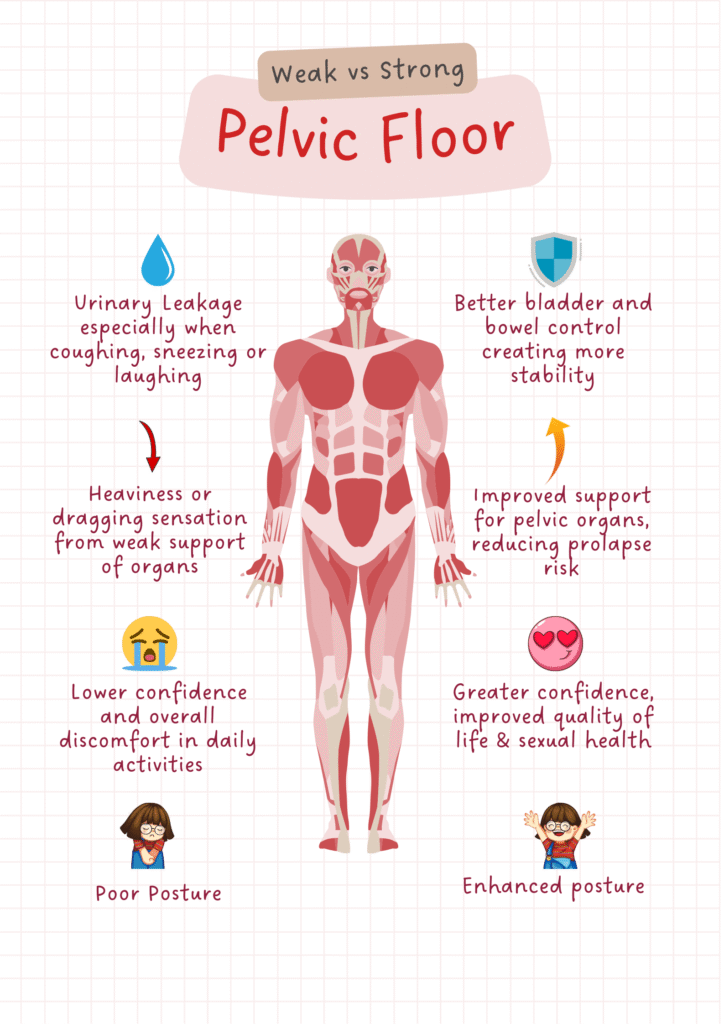
Improved circulation at the surface of tissues helps in eliminating waste products produced by metabolism such as lactate and inflammatory compounds, as well as dealing with regional ischemia and inflammation. The strength and suppleness of supportive connective tissues must be restored, particularly following childbirth or surgery, and this is achieved via the improved circulation, collagen synthesis and remodeling.
According to research, regular muscle activation can promote angiogenesis, or the development of new tiny vessels, strengthening the pelvic floor’s perpetual blood supply. In addition to promoting the urogenital mucosa’s wellness, proper circulation aids in the healing of microtrauma or scarring, which lessens pain and restores function. Hence, it is important to understand the 7 critical exercises to rebuild your pelvic floor, perform them under therapist’s supervision & ensure targeted results for recovery.
Evidence based Significance of Pelvic Floor Rehab in Males & Females
A systemic & meta analysis conducted in 2021, Therapeutic exercise to improve pelvic floor muscle function in a female sporting population, examined female athletes & physically active women. Following exercise regimens, it was discovered that pelvic floor muscle (PFM) training considerably increased the utmost voluntary contraction of the pelvic floor muscles and decreased urine leakage. This demonstrates that even women with high levels of physical activity can improve their pelvic floor strength and decrease dysfunction with focused training.
On the other hand, Randomised controlled trials of pelvic floor muscle exercises and manometric biofeedback for erectile dysfunction, involving men with erectile dysfunction were examined. Pelvic floor muscle training along with biofeedback and lifestyle changes group showed more prominent improvements in their erectile function scores after 3 months as compared to the group who were not performing exercises. This proves that pelvic floor strengthening is also vital for men & its strengthening can lead to quantifiable gains in overall pelvic muscle functions and sexual health.
7 Critical Exercises to Rebuild your Pelvic Floor
Exercises for the pelvic floor focus on the deep muscles which maintain your reproductive, bowel, and bladder. They are easy yet effective. If you perform them precisely, you may reinforce your core, gain better control, and lessen symptoms like fullness or leakage. Before beginning any particular exercises, it’s crucial to comprehend how to engage the pelvic floor correctly because it’s not a group of muscles that’s easy to see. To recover strength, coordination, and confidence in day-to-day activities, consider these 7 critical exercises to rebuild your pelvic floor as a systematic pathway that assembles upon one another.
1. Kegels
Among the 7 critical exercises to rebuild your pelvic floor, the very first one is kegels. Kegels are a set of exercises that particularly target the pelvic floor muscles. They entail carefully tightening and relaxing the pelvic muscles to increase coordination, strength, and endurance. Kegel exercises are beneficial for both men and women, particularly for conditions including prolapse, leaking, after prostate surgery, and postpartum recovery.
Therapeutic Uses
- Improved bowel & bladder control
- Lower risk of prolapse
- Enhanced sexual health in both male & female
- Core stability
How to Perform Kegels?
- Ask the patient to hold his urine to identify the right group of muscles. (Only for awareness)
- The muscles utilized in this action are the pelvic floor muscles & now ask the patient to contract or tighten them.
- Hold the contraction for about 5 seconds and then relax.
- Repeat 2 sets of this exercise with 10 to 15 reps in each as per tolerance.
- For safer practice watch Kegel exercise for the beginners.
PRECAUTION
Don’t practice the Kegels whilst urinating as it may lead to incomplete emptying of the bladder.
2. Quick Flicks
The second exercise out of the 7 critical exercises to rebuild your pelvic floor, is a type of pelvic floor exercise that focuses on short & faster contractions of the pelvic floor muscles instead of holding the contraction for a longer time span. They notably rehearse the fast twitch muscle fibers that are in control of quick, reflexive movements such as controlling the leakage whilst you laugh, sneeze or cough.
Therapeutic Uses
- Prevents leakage during sudden reflexive actions
- Improvises the pelvic floor muscles response to quick actions
- Assists in continence control
- Refines the muscle coordination
How to Perform Quick Flicks?
- Position the patient in a comfortable state such as sitting, lying or standing.
- Ask the patient to quickly squeeze his/her pelvic floor muscles and relax without holding for a longer time period.
- Take complete relaxation gaps in between for 2 to 3 seconds.
- Perform 2 sets of 10 to 15 reps or as per patient tolerance.
- For complete guide watch Performing Quick Flicks
PRECAUTION
Avoid performing more than the recommended sets as it may lead to muscle fatigue. Do not hold your breath while performing quick flicks as it may increase the strain on the pelvic organs.
3. Bridging with Kegel
It is a blend of core stability & pelvic floor strengthening. It requires to lift the spine and hips into a bridge position while performing kegels alongside.
Therapeutic Uses
- Strengthens the pelvic floor & increases its stability
- Promotes core stability helping in posture correction
- Provides functional strength to cope up incontinence
- Improves the blood flow to pelvic region
- Helps in sexual health
How to Perform Bridging with Kegels?
- Position the patient supine on the couch in a relaxed state.
- Ask the patient to bend his both knees with both feet flat on the couch & arms on the sides.
- Instruct the patient to perform the kegel contraction.
- Whilst performing kegels, slowly raise the hips to the ceiling, squeezing the buttocks & maintaing the kegels all along.
- Instruct the patient to hold this bridge position for approx 5 seconds.
- Lower down slowly & repeat 2 sets of 10 reps each as per tolerance.
- For better practice & safety watch Bridging with Kegels for Healthy Erection
PRECAUTION
Avoid arching your spine to prevent strain on the back, ensure your contraction is lifting upwards not backwards. Stop & seek immediate help in case of pain or discomfort.
4. Dead Bugs
The Dead Bug is a core stabilization exercise that involves synchronized arm and leg movements while lying supine. By intentionally contracting and lifting the muscles of the pelvic floor throughout the exercise, you can increase pelvic floor activation.
It assists in developing stability, equilibrium, and pelvic strength by combining limb movement with deep core stimulation targeting the abdominals, glutes, lower back & most importantly the pelvic floor muscles.
Therapeutic Uses
- Strengthens the pelvic floor muscles
- Helps reduce low back strain
- Functional for men & women in controlling bladder to prevent incontinence
- Improves the coordination between abdominals and pelvic floor
How to Perform Dead Bugs?
- Ask the patient to lie on his back in a supine position with both knees flexed at 90 degrees, keeping the shins parallel to the floor.
- Instruct the patient to gently press the lower back on the surface that you’re lying on & move the arms upright towards the ceiling.
- Now command him to engage his core along with the pelvic floor by relaxing the pelvic floor when inhaling and contract it during exhaling breathing pattern.
- Ask the patient to slowly lower his arm of the right limb and leg of the left limb creating a diagonal movement pattern.
- Do not touch the limbs to the surface you are lying at.
- Repeat this exercise by switching the limbs along with pelvic floor engagement.
- Recommended dose is 2 sets of 10 reps as per patient tolerance.
- For better understanding watch Relieve Pelvic Floor Pain with Dead Bugs
PRECAUTION
Avoid holding your breath and make sure to keep your lower back in a neutral position. Do not over squeeze the pelvic floor as it may strain the muscles further.
5. Wall Sits with Pelvic Floor Activation
The next exercise in the 7 critical exercises to rebuild your pelvic floor is the wall sits. A wall sit is a static exercise designed to strengthen the lower extremities in which you “sit” against a wall like you’re on a hidden chair. It combines leg and core strength with pelvic floor conditioning when paired with pelvic floor activation.
Therapeutic Uses
- Weight bearing with strengthening of the pelvic floor
- Improves the posture
- Strengthens the quadriceps, glutes and hamstrings
- Helpful in training the pelvic floor for the activities like lifting objects, squatting or standing for longer time periods
- Helps train the bladder for the conditions like coughing, sneezing or laughing
How to Perform Wall Sits?
- Instruct the patient to stand still against the wall with the body apart.
- Now ask him to slowly bend down in a position as if he or she is sitting on a chair.
- Ask the patient to gently inhale whilst keeping the pelvic floor relaxed and contract it upon exhaling. Keep the upper body supported against the wall.
- Hold the pelvic floor contraction for 10 seconds and gradually progress to more as per tolerance.
- Repeat 2 sets of 15 reps.
- Watch the complete guide here Wall Sits for Pelvic Floor Rehab
PRECAUTION
Avoid performing this exercise in case of postural hypotension or dizziness due to underlying medical issues. Keep a support mattress or cushion next to you while performing it in case of fall. Avoid arching your lower back away from the wall.
6. Planks
As we move past the 7 critical exercises to rebuild your pelvic floor, the focus is now shifted on advanced dynamic stability. Plank is a core conditioning exercise that targets the pelvis, shoulders, spinal column, and abdominals. When the pelvic floor is contracted along with it, the deep anchoring system (diaphragm + transverse abdominis + pelvic floor) is trained.
Therapeutic Uses
- Helps in training the pelvic floor against heaviness, leakage and instability
- Supports spine and improves posture
- Strengthens the pelvic floor in weight bearing position
- Suitable for men & women to train their pelvic floor muscles
How to Perform Planks?
- Ask the patient to lie prone on the surface and then gradually hold his body weight on his forearms as in pushup position.
- Now instruct to relax the pelvic floor when inhaling and contract when exhaling.
- Hold the contraction for about 5 to 10 seconds as per tolerance.
- Repeat 2 sets of 3 reps of this exercise and gradually progress to 20 second hold.
- Watch Planks with Pelvic Floor Activation for in depth understanding.
PRECAUTION
Avoid extreme tightening of the pelvic floor and do not drop down the body with force. Start with kneeling planks if the full plank position is too difficult to maintain. In case of pain, leakage or exaggerated pressure on the pelvic region, consult your physical therapist or physician immediately.
7. Hip Abduction with Resistance Band
The last exercise among the 7 critical exercises to rebuild your pelvic floor is hip abduction with resistance band along with pelvic activation. A combination of hip abduction with pelvic floor contraction can be used to progress towards the dynamic stability of the pelvic floor. It trains the pelvic floor to concurrent activation with the hip and core muscles while strengthening the gluteus medius and minimus, the primary hip stabilizing muscles.
Therapeutic Uses
- Helpful for pelvic alignment & improving posture
- Helps in training the pelvic floor to avoid leakage and feeling of heaviness
- Reduces the stress on lower back
- Assists in gaining hip stability
- Useful for both genders in training the pelvic floor activation in a right manner
How to Perform Hip Abduction with a Resistance Band?
- Ask the patient to stand with a resistance band placed around his thighs.
- Instruct the patient to slightly bend the knees with feet apart.
- Follow the same mechanism to train the pelvic floor, that is, inhale with pelvic floor in a relaxed mode and exhale while contracting it.
- Gradually move one leg away from the other, taking it far.
- Perform 2 sets of 15 reps as per tolerance.
- Hip Abduction with a Resistance Band along with Pelvic Floor Activation
PRECAUTION
Do not arch your back and keep both the feet steady on the floor. In case of pain or increased discomfort on the knees, stop the exercise immediately.
REMEMBER!
Physiotherapists frequently suggest the following exercises to promote pelvic floor health, however, every particular medical issue is different. Always consult a physician before diagnosing yourselves from doctor google. Before beginning or altering any workout regimen, talk with a competent pelvic health physiotherapist. Safety is the top priority; professional guidance and tailored treatment are always necessary.
To the Readers
The main purpose of writing this article is to encourage the people in our community and surroundings. It’s okay to ask for help if you’re having problems with your pelvic floor, whether it’s weakness, discomfort, heaviness, or leakage. Because a correct diagnosis guarantees safe and efficient medical care, speaking with your doctor is the first and vital step. Immediately following that, a pelvic health certified physiotherapist can lead you through customised exercises that will help your body regain control, strength, and coordination.
Regaining function is only one aspect of this path for both men and women. There are many other goals such as rebuilding self-esteem, wellness, and quality of life. Beyond your own healing, you have the ability to enlighten and uplift people around you. By ending the taboo and increasing awareness in the community and within your family, you foster an atmosphere that inspires others to get assistance as well.
The ability to heal becomes a common skill. Likewise, even though each recovery is different, basic, tried-and-true exercises like the seven we’ve covered can be effective tools for restoring and safeguarding your pelvic health. Make the first move because you care about your health and by opting to look after yourself, you encourage others to follow this example.
This article has been written by a Physical Therapist and provides general guidance on physical health & exercise. While it is grounded in professional expertise, it is not a substitute for individualized medical advice. If you are experiencing pain, specific symptoms, or have an underlying medical condition, please book a 1 on 1, 30 minute consultation with our expert physical therapist for a personalized assessment & tailored recommendations.
Pingback: The Diabetes of the Ovaries & Its Controlling Cure -