
One of the most prevalent musculoskeletal complaints is neck pain, which is frequently associated with improper posture, contemporary lifestyles, or underlying structural disorders. Since neck discomfort may originate from muscles, joints, nerves, or even transferred pain from other areas, a precise diagnosis is essential to successful therapy.
Table of Contents
TogglePhysiotherapists and other medical professionals can determine the underlying cause of symptoms rather than just the symptoms by knowing the structure and biomechanics of the cervical spine. A step by step guide to diagnose chronic neck pain can be done by integrating physical examination, history taking, and diagnostic testing, a scientifically based strategy guarantees that every treatment plan is accurate, supported by evidence, and customized to safely relieve discomfort and restore mobility.
As soon as the patient pursues the treatment regimen from their physical therapist, they come up with different levels of activity restrictions, functional impairments and critical diagnosis & are at a divergent level of healing. The basis of any treatment plan begins with a comprehensive examination to set the groundwork for effective fundamental interventions. Now you may wonder what we mean by fundamental interventions? The answer is simple. The fundamental interventions are a set of exercises or skills that every individual patient with spinal disablement should study & grasp irrespective of their level of impairment & what treatment they have been given by their therapist.
While we talk about fundamental interventions, it is important to highlight the significance of patient education & the Methods to relieve the stress of the patient. A thorough and detailed patient education is a primary constituent in every intervention. It includes a number of concepts & the patient as well as the therapist should be aware of it prior to their step by step guide to diagnose chronic neck pain. Initially the patient actively participates in determining the intended objectives; a component of this approach includes educating them about the possible results.
Muscle function in the spine includes flexibility in addition to strength, power, and longevity. In order to establish spinal stability, it is essential to activate the deeper segmented muscles along with the external multi-segmental muscles of the neck and trunk. Initially, the focus was on the control and contraction of muscles and the awareness of the spinal position when rotating the extremities and carrying out basic functional tasks.

Furthermore, it might be necessary to let the patient know about the restrictions at each phase of recovery so that they won’t worry that the acute symptoms will always be incapacitating. However, they also shouldn’t engage in excessive workouts and activities in the early subacute period that might worsen the symptoms they are experiencing. In the final phases of rehabilitation, the patient can then require encouragement to move past imagined barriers.
In order to guarantee that each patient acquires knowledge to cope with their symptoms and any deficits, it is crucial that they participate in every task at every step of their recovery and are not merely resigned recipients of “therapy.” To achieve the highest level of functional restoration with the fewest limitations on activity or involvement, teach the patient how to safely advance self-management beyond the period of time spent under expert supervision. Hence, this is where step by step guide to diagnose chronic neck pain plays a vital role. The more a therapist knows about the impairment, the more he can educate the patient regarding it.
Step by Step Guide to Diagnose Chronic Neck Pain
Although plenty of therapists might not always perform these stages sequentially, the therapeutic process typically starts with the discovery that provides a clear indication of the issue. The fact that there are several overlapping reasons for neck discomfort must be understood, though, as ignoring one of them could prevent a proper diagnosis. This thorough, evidence based guideline was created in order to highlight the significance of looking at all aspects of evaluation, including history, special tests, and imaging. With the help of this detailed framework, aspiring physiotherapists and students will be able to make sure that every diagnostic choice is comprehensive, well-informed, and focused on the patient.
1. Quick triage for Warning signs
Importance
The very first objective in step by step guide to diagnose chronic neck pain is to exclude causes that are serious or life threatening and require referral or investigation right away. Always educate the people around you to act urgently when such cases come through.
What to ask?
- Any cancer history
- Unexplained weight loss
- Severe headache
- Epistaxis
- Gait impairments
- Gradual onset of weakness
- Inability to control bowel & bladder function
- Severe trauma to any area of the body
- Instant swelling or bruising
2. Extensive History
Importance
Comprehensive questioning can lead to the root cause of the disability.
Key points to focus
- The onset of pain & its cause {any case of trauma, hit, fall etc.}
- The characteristic of pain
- If the pain is radiating
- Is the pain accompanied with numbness, tingling or swelling?
- Aggravating factors
- Relieving factors
- Previously taken treatments/diagnosis/medications if any
- The nature of job
- The posture adapted
- Any comorbidities related to this
- Level of stress, job dissatisfaction & fear of movement
3. To Scrutinize the Pain Level
Importance
The third intent of step by step guide to diagnose chronic neck pain is evaluating the levels of pain. By understanding the pain levels, therapist can customize the intervention regimen accordingly and precisely.
Inquire from Patient
- Numeric pain rating scale – to know the level of pain & discomfort the patient is going through
- Neck disability Index – to assess how neck pain affects daily functioning and the degree of impairment in patients with neck related disorders
- Patient Specific Functional Scale – to develop a customized, subjective assessment of functional limitations
4. Comprehensive Physical Examination
Importance
Physical exam helps direct imaging and tests and determine the likely origin.
Objectives to Cover during a Physical Exam
- Pay attention to the posture
- Check the movement pattern along with scapular symmetry
- Palpate the soft tissue for triggers
- Test the dermatomes, myotomes & reflexes integrity
- Look out the gait pattern along with coordination of both limbs
- Test the Cranial nerves
- Perform the special tests that includes Spurling’s test (provocative), Cervical distraction test (for radicular pain), & Upper limb neurodynamic tests.
5. Imagings and Tests to Order
Importance
The most important objective in step by step guide to diagnose chronic neck pain is scans. Imaging can rule out significant disease or establish structural root causes, but routine imaging is not advised for chronic neck discomfort that is not specific unless it is necessary.
Why should you order an Imaging test?
- Imaging right away if there are warning signs or recent severe trauma
- The most common examination for anticipated radiculopathy with increasing or severe neurological loss, potential myelopathy, or when surgical intervention is being considered is an MRI of the cervical spine
- X rays in case of structural deformities, degenerative dysfunction, or chronic symptoms
- NCS to rule out any nerve involvement
- Blood tests & MRI with contrast in case of inflammation or infection
6. Never forget the Differential Diagnosis
Importance
Out of all the steps in step by step guide to diagnose chronic neck pain, the most vital one is differential diagnosis. There may be multiple causes of chronic neck pain, so always think about your options.
Common Differentials to Consider
- Cervical radiculopathy due to Disc herniation
- Whiplash
- Cervical myelopathy
- Referred pain from thoracic spine, shoulder or TMJ
- Fracture
- Spondyloarthropathy
- Tumor
7. Clinical Reasonings for your Diagnosis
Importance
Clinical reasoning guarantees that the diagnosis is backed up by patient reactions, patterns of results, and expert opinion rather than being based solely on a single sign or test.
Combine the necessary Information
- Classify the pain as non-specific mechanical pain if it gets better with rest, aggravates with movement along with normal neurological exam
- Cervical radiculopathy is likely the case if the pain travels in a dermatomal fashion accompanied by positive Spurling and disrupted reflexes or the myotomes. In that occurrence, order an MRI to locate the lesion.
- In case of hyperreflexia, bilateral hand clumsiness along with gait disturbance, myelopathy is suspected.
- If the patient experiences fever, weight loss, or nocturnal agony, check for infection or cancer very away.
When developing a working diagnosis, physiotherapists frequently use these types of findings and step by step guide to diagnose chronic neck pain. However, every patient has a different disease, and symptoms can change depending on past medical records or underlying health issues. Clinical reasoning should never take the place of a comprehensive medical evaluation, even while it aids in directing appropriate physiotherapy care. Always get a thorough evaluation from your health care provider or another trained healthcare professional before beginning or altering any treatment regimen.
8. Document, Discuss & Design
Importance
Realistic goals and clear explanations are necessary for patients with chronic pain. They must know that the pattern of exercises & modalities may take time to fully recover their concerns.
What you should do being a Physical Therapist?
- Explain the cause, the condition & the pattern of symptoms to the patient once documented
- Support your work with the findings
- Discuss with the fellow supervised therapists if necessary
- Design your intervention with progressive stages as per tolerance of the patient
- Educate the patient regarding the expected timeline of recovery
- Address the red flags
- Make short goals that are easy to achieve to keep the momentum of rehabilitation going
- Reassure the patient about his recovery
- Develop a friendly & encouraging environment for the patient
- Aid the patient in eliminating the factor of kinesiophobia
9. Follow up
Importance
The final objective in the step by step guide to diagnose chronic neck pain is follow ups. Follow up ensures that the treatment of patients is always adaptable, safe, and sensitive to any modifications in the patient’s condition. Regular evaluation aids in determining the effectiveness of the present management approach because chronic neck pain may evolve over time, with symptoms potentially becoming better, staying the same, or getting worse. The physiotherapist can make the required modifications to maximize healing by tracking pain levels, functional results, and adherence to recommended exercises through follow up.
During Follow ups look for
- Progressive change in symptoms
- If the treatment is no longer effective
- Patient is experiencing more discomfort rather than comfort
- If the patient reports any neurological signs
- If the imagings rule out any surgical pathology or condition in which rehabilitation might be contraindicated
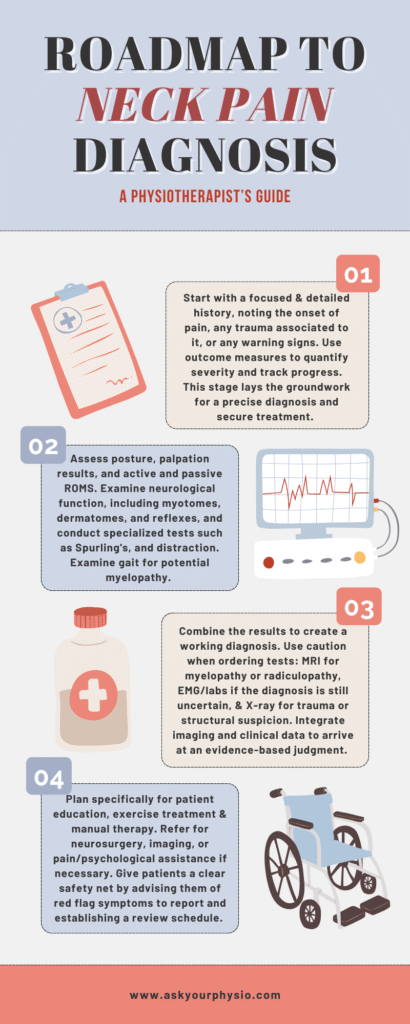
When we talk about a step by step guide to diagnose chronic neck pain we mean a comprehensive plan that should be executed. The foundation of successful physiotherapy treatment for persistent neck discomfort is a thorough examination procedure. In order to identify the actual cause of dysfunction, each step, from the patient’s history and examination to the diagnostic analysis and monitoring, carries out a particular purpose. Ignoring or hurrying through these processes can result in a lack of comprehension and, eventually, inadequate treatment results.
In addition to improving recovery, therapists establish an absolute basis for therapeutic confidence and accuracy by meticulously ruling down likely reasons and determining the precise nature of the issue.
In addition to addressing the patients with this plan, such kind of attention helps the therapist develop their expertise, supports lifetime learning, and equips future therapists to treat their patients with the same assurance and clarity. Accurate diagnosis is basically all about improving practice, gaining a deeper understanding, and creating a lasting influence on physiotherapy care, not merely about alleviating pain.
This article has been written by a Physical Therapist and provides general guidance on physical health & exercise. While it is grounded in professional expertise, it is not a substitute for individualized medical advice. If you are experiencing pain, specific symptoms, or have an underlying medical condition, please book a 1 on 1, 30 minute consultation with our expert physical therapist for a personalized assessment & tailored recommendations.
Pingback: 10 Exercises that can Beat Down Injuries Before They Occur -
Pingback: Is Walking a Part of Exercise Regimen? -
Pingback: The Alarming Impact of Your Negative Thoughts on Your Body -
Pingback: 6 Exercises to Heal the Posture Breastfeeding Quietly Wrecked -