
Stroke encompasses more than just abrupt mislaying movement or associated sensations. Cerebrovascular accident or stroke is a multiplex neurological incident that can easily damage diverse regions of the brain. Out of these locales comes the Broca’s & Wernicke’s speech areas, which are responsible for speech interpretation & governing as well as the primary motor cortex & medulla oblongata which dovetail the intricate act of swallowing. Impairment of these & this is why we will be exploring the proven effects of kinesiotaping on post stroke dysphagia.
Table of Contents
ToggleWhilst kinesiotaping is still under discussion in several rehabilitation societies, with many physical therapists supporting its functionality meanwhile others being skeptical about it. However, the new advance researches prove its worth & standing in the world of rehabilitation, highlighting its potential benefits. According to clinical research and case studies, kinesiotaping can help stroke survivors by promoting facial symmetry, increasing swallowing function, and boosting muscle activation when used appropriately.
Its efficacy in promoting focused after stroke recovery is becoming harder to ignore, even if it is not yet widely accepted as the standard of care. This gives patients and caregivers seeking complementary approaches to traditional rehabilitation hope. This innovative approach to stroke rehabilitation raises the possibility that something as basic as applying tape to the skin could affect proprioception, muscle coordination, and neuronal pathways, all of which are crucial for restoring function following brain damage. Lets explore some proven effects of kinesiotaping on post stroke dysphagia.
What really happens in Dysphagia?
Before we dive into the proven effects of kinesiotaping on post stroke dysphagia lets understand what dysphagia is. Many stroke survivors experience dysphagia that is known as difficulty in swallowing & muscle paralysis or facial paresis, particularly if the stroke affects brain regions or neural pathways involved in swallowing or facial motor function.
The intricate process of swallowing necessitates accurate timing when moving from the oral phase to pharyngeal phase along with an intact sensory sensory feedback system to initiate the swallow reflex & coordinated function of the oropharyngeal muscles which includes the tongue, suprahyoid muscles, laryngeal elevators for safe airway preservation.
Damage to the central pattern generators in the medulla oblongata along with the sensory motor pathways can affect both motor activation & sensory feedback system of swallowing. This increases the risk of aspiration, choking, malnourishment, or pneumonia because the swallow reflex may be delayed or missing, the tongue or suprahyoid muscles may be weak, and coordination may be lost.
Furthermore, even the muscles that are necessary for safe and effective swallowing such as genioglossus, hyoglossus, styloglossus in tongue, mylohyoid, geniohyoid, stylohyoid & digastric of the suprahyoid group, the pharyngeal muscles, soft palate muscles, intrinsic laryngeal muscles & esophageal muscles, as well as those responsible for perioral control may exhibit decreased activation, delayed responses, or diminished muscle strength following a stroke. This can lead to not only difficulty in swallowing but also drooling, difficulty in expectorating the secretions through effective cough, weak facial control or closing of the lips, or impaired facial symmetry. These concerns may decrease the overall wellbeing & quality of life, baffle the process of treatment through rehabilitation & limit the early return to oral feeding.
Dysphagias & Brainstem Strokes
In brainstem strokes, injury to both the motor & sensory elements of swallowing can cause tenacious deficits that are hard to recover from. A research published in 2025, Pathophysiology and Etiology of Brainstem Related Dysphagia, explored the physiological underpinnings of swallowing and how different brainstem disorders affect it, only to find out:
- Volitional and spontaneous swallowing exhibit distinct behaviors
- The volitional swallowing which is the one a person does on purpose, is more damaged following a brainstem stroke because it is regulated almost entirely through the cortical areas.
- Spontaneous swallowing is partially preserved as it depends on the brainstem reflex pathways. This clarifies why some stroke victims have trouble swallowing food or water yet are able to swallow saliva.
- EMG can rule out swallowing muscle dysfunction almost accurately
- EMG data revealed swallowing muscles (particularly the suprahyoid and infrahyoid muscles) with altered timing, decreased amplitude, or delayed activation.
- This indicates that dysphagia is measurable and quantifiable rather than merely an “impressionistic complaint.”
- Stroke not only disrupts the strength but also the coordination
- This lends credence to the theory that neuromuscular disarray rather than only muscle loss is the cause of dysphagia.
Conventional rehabilitation frequently concentrates on oromotor movements, swallowing exercises, compensatory tactics (positioning adjustments, dietary alterations), and occasionally neuromuscular electrical stimulation due to this multifaceted impairment which combines muscular weakness, diminished coordination, and sensory motor disconnection. Recovery, however, may be sluggish, insufficient, or unsatisfactory.
Kinesiotaping stands out as a possible option because of this gap, which has sparked interest in alternative, adjuvant modalities meant to enhance muscle acquisition, sensory input, and restoration to function. Hence, forming the basis of proven effects of kinesiotaping on post stroke dysphagia.
Inside the mechanism of Kinesiotaping
Kinesiotaping operates through an amalgam of mechanical, sensory & neurological effects that combined support post stroke recovery. The tape continuously stimulates the skin over the relevant muscles, giving mild impulses to the nervous system’s centers that can improve proprioception, which is the brain’s sense of position of the body.
In areas that are weak or paralyzed, this increased sensory input might enhance muscular activation, directing more efficient mobility during rehabilitation treatments. Kinesiotape can provide minor skin lifting mechanically, which may help with lymphatic drainage, lessen the extracellular edema, and enhance localized blood circulation, benefits that are especially helpful in hemiplegic extremities and facial tissues.
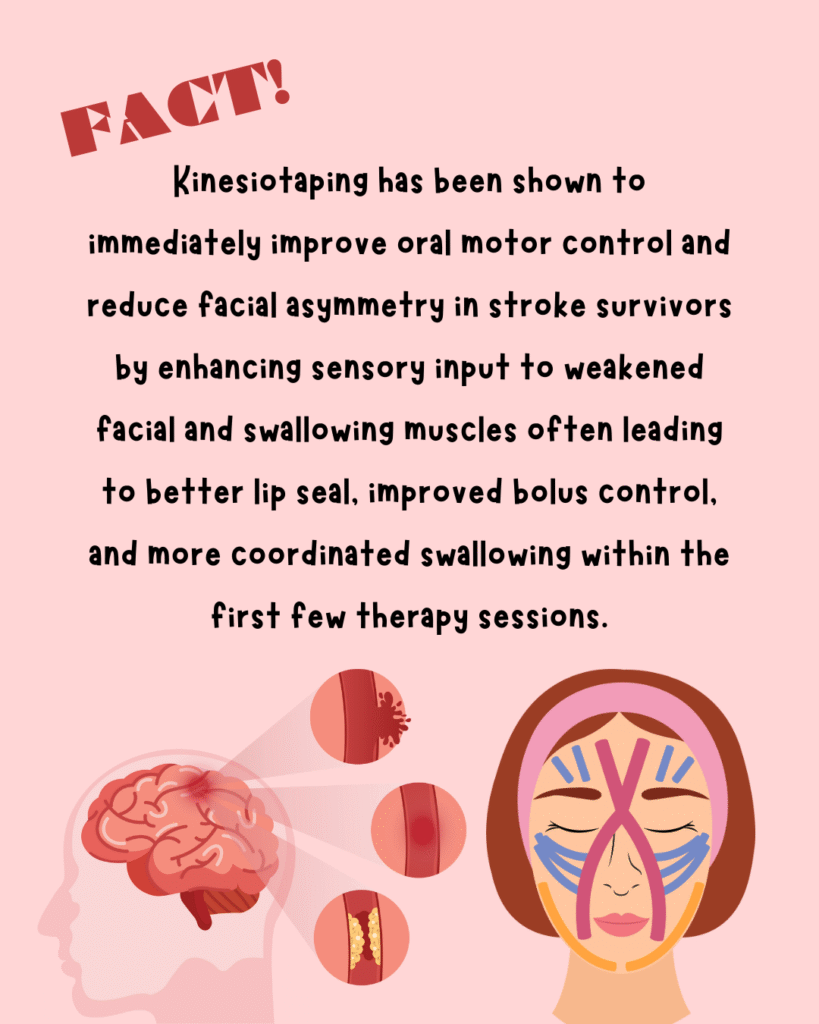
The tape also serves as a neuromuscular indicator, encouraging patients to use particular muscles when doing functional tasks like gulping, chewing, or grinning, which might hasten brain restructuring and motor relearning. Kinesiotaping essentially connects the dermis, muscle groups, and cerebral cortex in an ever changing feedback loop to enhance the effects of therapy without actually moving the patient’s muscles. Instead, it works in tandem with active rehabilitation.
Read 8 Essential Facts to know about Stroke Rehab to dive deeper into the world of rehabilitation.
Proven Effects of Kinesiotaping on Post Stroke Dysphagia
Recent studies have begun to examine KT as a lot more than just a skin tape for support, its importance as a technique to affect oropharyngeal muscle activation, improving the overall swallowing dynamics, and salivation management in after stroke dysphagia cases. An RCT Effect of Dysphagia Rehabilitation Using Kinesiology Taping on Oropharyngeal Muscle Hypertrophy in Post-Stroke Patients, reported that applying KT with appropriate tension to the hyolaryngeal complex combined with scheduled swallowing exercises led to significant increases in muscle thickness as compared to the control group.
This implies that KT may aid in “strengthening” or rehabilitating the oropharyngeal muscles that have been atrophied or compromised as a result of neurologically caused inactivity.
Another RCT set side by side the standard swallowing therapy, neuromuscular electrical stimulation, & kinesiotaping in post stroke dysphagia patients. A number of metrics, including bedside water-swallow tests, patient reported swallowing function (EAT-10), endoscopic swallowing measures (penetration-aspiration scale, FEES), and oral intake scale (FOIS), demonstrated substantial advancements in KT groups (with or without NMES).
These gains continued during subsequent assessments, including three months later, indicating that Kinesiotaping as a component of a dysphagia rehabilitation program may have lasting advantages. Effect of swallowing rehabilitation using traditional therapy, kinesiology taping and neuromuscular electrical stimulation on dysphagia in post-stroke patients
More generally, a very recently published meta-analysis that combined 12 randomized controlled trials with 724 stroke patients found that Kinesiotaping greatly enhanced the quality of life, beneficial swallowing rate, and swallowing function scores in stroke patients with pharyngeal-phase dysphagia. According to the results published by The efficacy of Kinesiotaping in patients with post-stroke dysphagia: A meta-analysis, kinesiotaping seems to be an advantageous addition to traditional therapy for enhancing nutritional status, operational intake via the mouth, and swallowing safety.
In addition to this, there is evidence that kinesiotaping may assist in improving swallowing and strength of the muscles as well as salivation problems, which are frequently present when oral motor function is impaired. This is a crucial but little discussed area of post-stroke therapy. In a control study named Effect of Kinesiotaping on salivation for stroke patients with dysphagia, published in 2022, in comparison to controls, stroke patients with excessive salivation (drooling) and dysphagia who underwent KT in addition to standard rehabilitation exhibited more improvement in oral intake, swallowing competence (water swallow test), and the severity of their drooling.
This implies that kinesiotaping may assist control oral secretions in addition to muscle activation, enhancing patient comfort, safety, and hygiene.
7 Effective Exercises that can be performed along with Kinesiotaping to target Post-stroke Dysphagia
Effortful Swallowing
- Aim: Strengthens the pharyngeal constrictors, suprahyoid muscles, and base of the tongue.
- To Perform: The patient is advised to swallow as forcefully as they can, using all of their pharyngeal and oral muscles
- Taping synergy: Kinesiotape over the suprahyoid region to ensure both both muscular facilitation and sensory inputs
Mendelsohn Maneuver
- Aim: Prolongs laryngeal inclination to enhance upper esophageal sphincter opening and airway protection.
- To Perform: The patient is asked to hold his/her adam’s apple for about 3 to 5 seconds before completing the mechanism of swallowing
- Taping synergy: Kinesiotape over the anterior aspect of the neck can help assist & escort laryngeal elevation
Shaker Head lifts
- Aim: Enhances upper esophageal sphincter opening & strengthens the suprahyoid muscle
- To Perform: The patient lies flat and raises their head while keeping their shoulders on the bed. Hold this position for a minute, then repeat three times.
- Taping Synergy: Kinesiotape under the chin & along the anterior aspect of the neck to achieve tactile feedback, aiding in muscle activation
Tongue Resistance Exercises
- Aim: Strengthens the tongue enough for bolus propulsion during swallowing
- To Perform: Ask the patient to press his tongue against the hard palate or tongue depressor holding for 5 to 7 seconds. Repeat this exercise 10 times twice daily
- Taping synergy: Kinesiotape along the Hyoglossus muscle or floor of the mouth to enhance proprioceptive feedback responses
Tongue Hold Maneuver
- Aim: Increases the strength of the pharyngeal constrictor muscles and the movement of the posterior pharyngeal wall
- To Perform: Swallow saliva while softly holding your tongue between your teeth. Repeat this 5 to 10 times twice daily
- Taping synergy: Kinesiotape on suprahyoid muscle to enhance muscle engagement
Facial Muscle strengthening
- Aim: Enhances cheek strength, symmetry, and lip closure
- To Perform: Ask the patient to smile widely & hold for 5 seconds, puff his cheeks & resist with hands, make pucker lips & hold for 5 seconds. Repeat these 10 times twice daily
- Taping synergy: Applying KT along the zygomatic, orbicularis oris, and cheek muscles improves sensory awareness and muscle activation.
Chin Tuck in against Resistance
- Aim: Enhances hyolaryngeal elevation and fortifies the anterior neck and suprahyoid muscles
- To Perform: The patient gently presses their chin on a resistance band or soft ball, holding the position for 5 seconds. Repeat this 10 times or as per patient’s tolerance
- Taping synergy: Kinesiotape applied along the anterior aspect of the neck to guide correct mobility & positioning during the exercise
Additional Tips
- Repetitions and frequency: The majority of research recommends two to three sets daily, 5 to 7 days a week.
- Safety: Begin with sessions under supervision; keep an eye out for signs of exhaustion or aspiration danger.
- Combination: KT applied over the targeted muscles provides proprioceptive input, support, and sensory cueing, making these workouts most effective.
Is Kinesiotaping the Solution of Post-Stroke Dysphagia?
Kinesiotaping is becoming more popular as stroke rehabilitation develops, which is indicative of a larger trend toward patient centered, accessible, non-invasive, and effective therapy. By supplying constant sensory input, promoting muscle activation, and bolstering neuromuscular coordination throughout swallowing and face motions, kinesiotaping may improve recovery in post-stroke dysphagia, according to new research. By strengthening proprioceptive feedback and promoting more effective motor relearning, kinesiotaping seems to enhance therapeutic results when paired with traditional swallowing exercises and vigorous rehabilitation.
It is particularly attractive in environments where cutting-edge technology might not be easily accessible because of its low cost, simplicity of use, and low risk profile. Although kinesiotaping has not yet been demonstrated as a stand alone treatment, its use as an adjuvant therapy has a lot of potential, especially as investigation evolves to improve patient selection, dosage, and application methods. Kinesiotaping may become a crucial part of holistic dysphagia management following a stroke as clinicians and researchers gain a deeper understanding of how basic sensory stimulation can affect intricate neural pathways.
This raises the question of whether the potential of rehabilitation resides not only in sophisticated machines but also in creative, evidence based applications of fundamental instruments that restore the brain, muscles, and functionality.
This article has been written by a Physical Therapist and provides general guidance on physical health & exercise. While it is grounded in professional expertise, it is not a substitute for individualized medical advice. If you are experiencing pain, specific symptoms, or have an underlying medical condition, please book a 1 on 1, 30 minute consultation with our expert physical therapist for a personalized assessment & tailored recommendations.