
When we talk about wrist pain & its causes, our first & foremost guess is De Quervain Tenosynovitis or in most cases we think it might be an invisible scaphoid fracture. But the real question is, what if both these diagnoses are ruled out? How to find the real suspect? Diagnosing the wrist pain can be extremely difficult because the wrist is a tiny, complex joint composed of numerous sensitive components that interact tightly.
Table of Contents
ToggleThe Anatomical Configuration of the Wrist Joint
The intricate configuration of the wrist joint’s muscles, ligaments, connective tissues, and nerves enables a variety of precise motions. It is made up of eight tiny carpal bones grouped in two rows, the proximal and distal carpal rows, and the articulation with the distal ends of the radius and ulna. Strong ligaments hold these bones together, allowing for flexibility while maintaining stability. Tendon wraps that lessen friction shield the tendon sheaths which regulate hand and finger motion as they travel through the wrist from the forearm muscles. This region is extremely sensitive since major nerves such as the radial, ulnar, and median nerves pass through it.
Diagnosing the Wrist Pain with a Case Study
A 25 year old male physician presented with a complaint of pain in right wrist for about a year. The patient was a male physician, age 25, who had been complaining of right wrist pain for about a year. He employed his right hand to avert the fall after he unintentionally tripped on a stairway, which is how the narrative started. The damage appeared to be mild at first; there was only a sharp pain along the radial side of the wrist and around the base of the thumb, with no obvious swelling or deformity. Soon after, an X-ray was taken, showing no evidence of a fracture, and he was told to take it easy for a few days.
Over time, though, the pain did not entirely go away. At times, the doctor said, it was terrible and would sometimes radiate up near the forearm. He observed that the pain was worse when he did specific things, particularly when he had to lift heavy things, write for extended periods of time, or make the delicate hand motions needed for his medical studies. These activities would trigger the intense pain again, which frequently made it hard for him to concentrate on his daily chores.
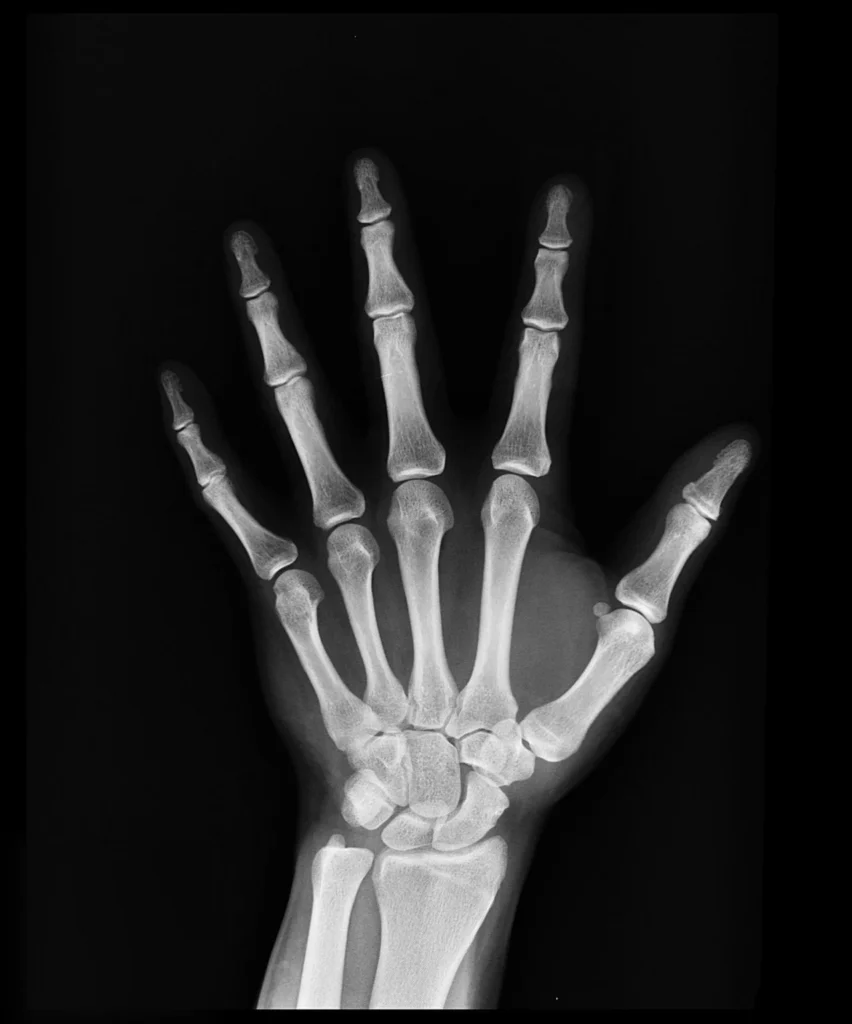
The X-ray showed no structural damage and remained clear even after several reevaluations. However, his everyday and professional life continued to be disrupted by the persistent discomfort, which is a common occurrence for people with soft tissue or ligamentous wrist traumas that are frequently missed by routine imaging. This instance demonstrates how not all injuries to the wrist show up on an X-ray. The wrist joint is extremely intricate and sensitive.
These complex mechanisms can be upset by even a small fall, and if treatment is not received, persistent pain may result. A simple wrist sprain might be mistaken for conditions like a scapholunate ligament sprain, a CMC joint strain, or an undetected scaphoid injury, making diagnosis difficult.
Physical Therapy Guide - Examination & Diagnosis
The real point lies in diagnosing wrist pain, the actual cause of it. The following lists the main diagnoses to rule out or rule in, what to check for during an examination, and what results raise suspicions.
Scapholunate Ligament Injury
- History of falling onto an outstretched hand, persistent pain, particularly while lifting or under pressure, and a potential snapping or breaking way sensation. The wrist’s dorsoradial side hurts.
- Perform the Watson or Scaphoid Shift test
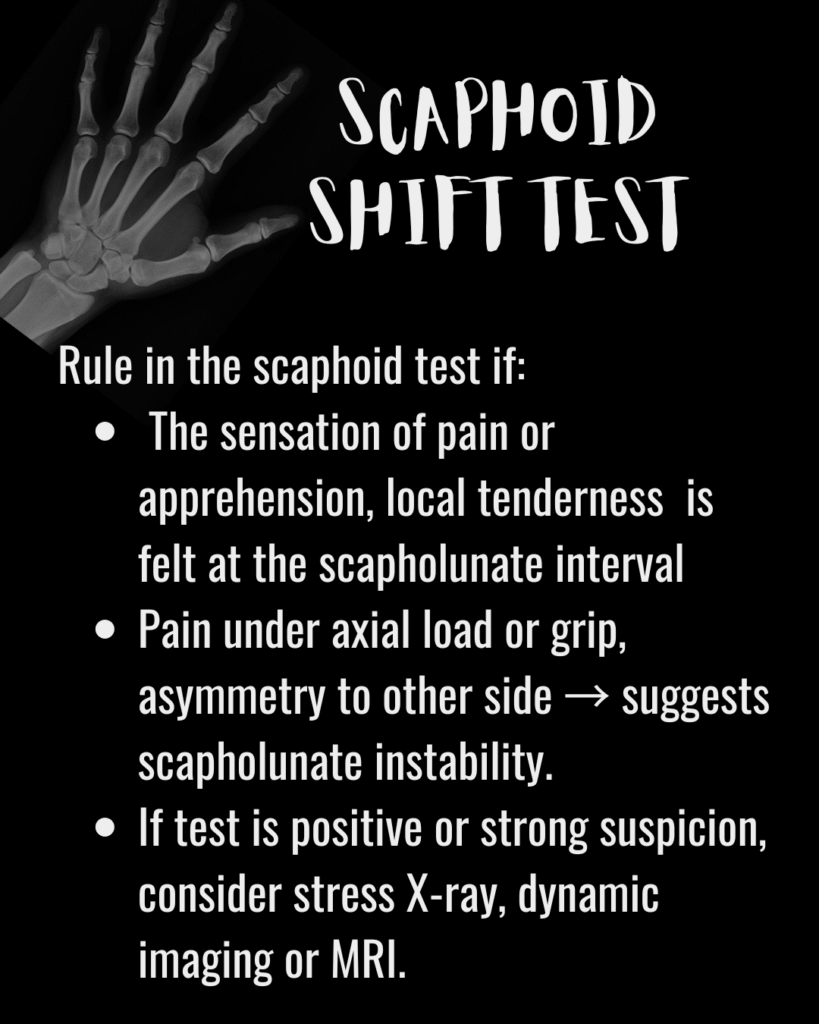
- Scapholunate Ballottement Test
- Palpate the Scapholunate interval
- Compare the ROM of the wrist along with gripping power under axial loading
The Ligamentous Sprain of the Wrist
- Movement or loading related generalized radial side pain but with no obvious symptoms, possibly some instability feeling.
- Palpate the Radial Collateral ligament or the Radioscaphocapitate ligament areas
- Examine wrist pain by doing resisted movements that put strain on the ligament such as resisted ulnar & radial deviation
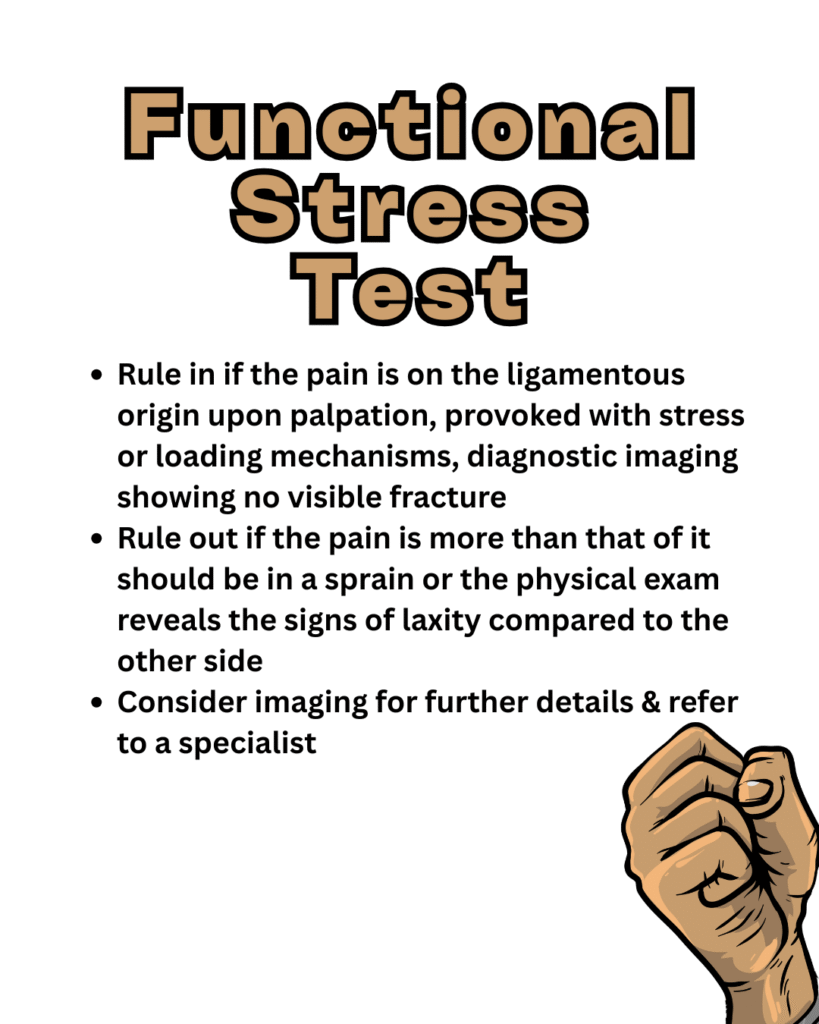
- Function Stress test – Pain on heavy lifting or gripping with load
Thumb Carpometacarpal Joint Arthritis or Injury
- Pinching, writing, lifting, and rotational or axial loads on the thumb all exacerbate the pain near the base of the thumb. Long hours of writing are made worse by pinching or twisting lids.
- Lateral Stress test of carpometacarpal joint ligaments
- Lever test or pinch test
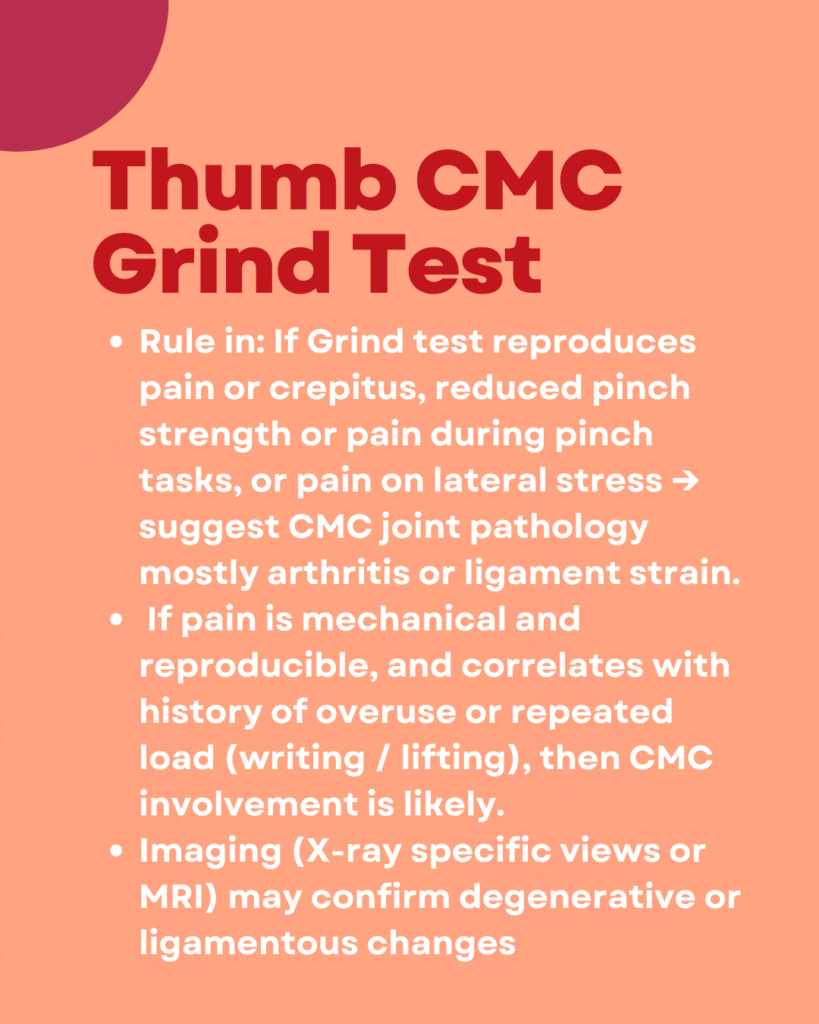
- Grind test
Missed Scaphoid Fracture
- The presence of prolonged pain following damage, discomfort in the anatomical snuffbox, pain with loading, and a history of falls on the outstretched hand.
- Palpate for the tenderness on the Scaphoid tubercle
- Scaphoid compression test
- Palpation of Anatomical Snuffbox tenderness

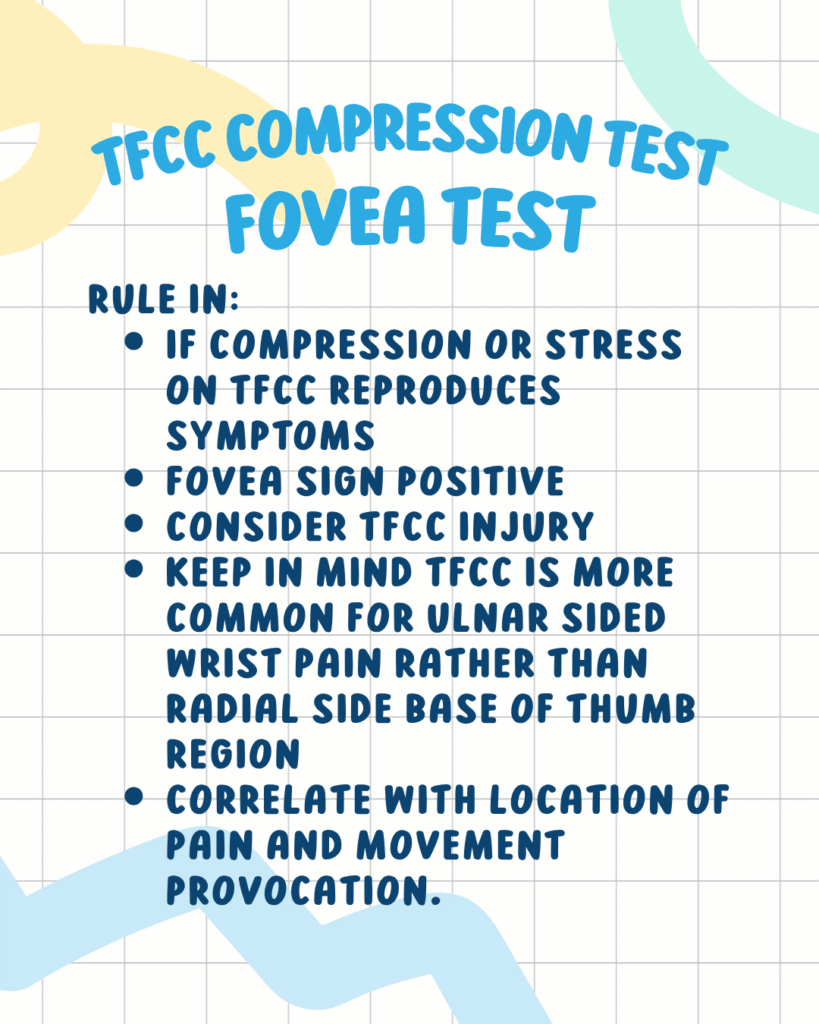
Triangular Fibrocartilage Complex Injury
- Given that it is typically associated with ulnar sided discomfort, wrist instabilities or problems with load transfer may be contributing factors.
- Consider TFCC if the patient additionally reports pain during pronation, supination, or ulnar deviated loading.
- TFCC Compression test
- Fovea Sign – tenderness distal to styloid process
Intersection Syndrome
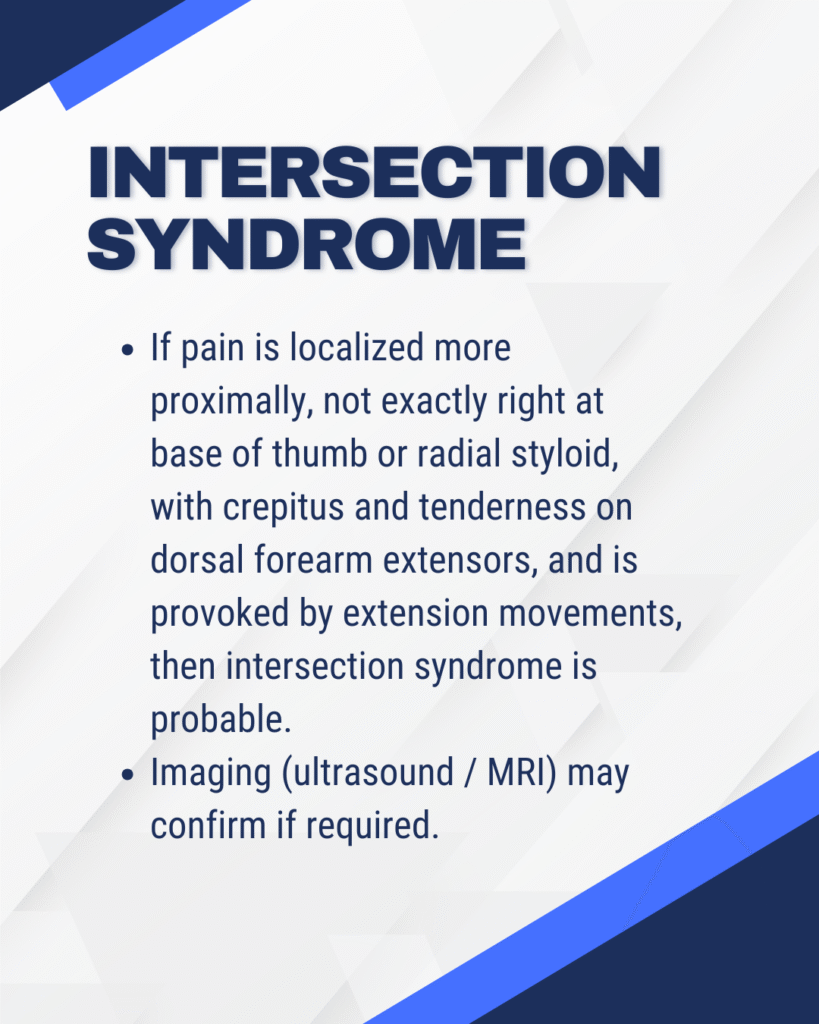
- More towards the dorsal proximal radial side
- Take it into consideration if the patient experiences proximal pain on the dorsal forearm or near the extensor compartments, particularly if it gets worse with wrist or thumb extension or crepitus.
- Palpate for tenderness to rule out swelling over the radiodorsal forearm
- Use resisted wrist or thumb extension to check for crepitus at that location.
- Resisted Provocative Test that reproduces pain on resisted thumb extension
How to Use this Guide:
Begin with History taking & Symptoms Mapping
- Which particular part of the wrist hurts?
- What movement patterns provoke it?
- Is there tingling or numbness along with the symptoms?
Conduct a series of tests while doing a Physical Examination
- Palpate these areas first: the snuffbox, extensor compartment, scaphoid tubercle or the area of pain
- Perform the respective tests as mentioned earlier according to the site & nature of symptoms
- Compare with the healthy side to rule out swelling, reduced ROM or laxity
Interpret the results as a Combination of findings
Focus on the positive test results as well as the area of injury & location of the pain
When to consider Imagings
- Unsettling test results or ongoing discomfort despite conservative treatment that is, persistent pain on the base of the thumb or the snuffbox, positive instability tests
- While waiting for imaging, take into account splinting or immobilization trials particularly for suspected occult scaphoid fracture
Document the findings
Determine whether to treat conservatively or consult an orthopedic based on positive or negative tests, the degree of discomfort elicited, and comparison to the opposing wrist or thumb
What we Learn from this?
One thing unites wrist injuries like scapholunate ligament ruptures, wrist sprains, thumb CMC injuries, collateral ligament injuries of the thumb, occult scaphoid fractures, TFCC damage, tendon sheath inflammation like intersection syndrome, and nerve compressions: they frequently follow falls, excessive use, or vigorous wrist movements. The wrist is susceptible to even little injuries since it is a small joint with numerous tiny ligaments, bones, and tendons tightly bound together.
Falling on a hand that is stretched out (FOOSH), abrupt twisting motions, forceful gripping, repetitive typing or writing operations, racquet sports, weightlifting, and tasks demanding extended wrist extension are risk factors. Susceptibility is further increased by anatomical variations, which include ulnar variance, ligament laxity, or prior injury.
One of the primary contributors of these damages among manual laborers and sportsmen is repetitive microtrauma. When these structures are damaged, they might cause overlapping symptoms, such as discomfort at the base of the thumb, radial side, ulnar side, or across the dorsal wrist, which makes diagnosis difficult without appropriate clinical testing. To lessen the strain on healing tissues, management starts with activity restriction, rest, and occasionally wrist immobilization. Ice, anti-inflammatory techniques, bracing, and mild, painless movement are effective treatments for acute injuries.
A more systematic approach is needed for recurrent or ongoing cases: progressive physiotherapy that includes proprioceptive training, wrist stabilization enhancement, forearm muscle strengthening, and the restoration of strain reducing movement patterns. While ligamentous injuries necessitate stability and grip recovery, tendon related issues such as intersection syndrome or de Quervain’s frequently are helped by eccentric strengthening. Modern methods of imaging like MRI or ultrasound may be necessary to detect latent rips or covert fractures if symptoms continue after rehabilitation.
Strengthening, ergonomic knowledge, and enhancement of technique are all necessary to prevent wrist injuries. Adequate preparatory exercises, forearm stretching, and strengthening of the wrist flexors, extensors, pronators, and supinators should be matched with activities that repeatedly strain the wrist, such as heavy lifting, racquet sports, push ups, or extended periods of writing or typing.
It’s crucial to use good technique when exercising or playing sports, to avoid abrupt boosts in intensity of training, and to make sure you get enough recovery in between high load activities. People who work in jobs that require repeated motion should think about using ergonomic tools, minimizing wrist deviation, taking microbreaks, and practicing neutral wrist positions. When doing demanding jobs, people with a history of wrist discomfort or unsteadiness ought to prevent high impact falls and employ supportive taping or bracing.
All things considered, the wrist is a delicate yet extremely useful joint that depends on healthy ligament integrity and balanced muscle control. Small injuries can be kept from developing into chronic problems by identifying signs early on, such as clicking, intense localized ache, grip weakness, or swelling. Most people can resume full activity without permanent limitations with an organized approach that includes appropriate diagnosis, focused rehabilitation, and persistent load control. By diagnosing the precise structure affected, customizing exercises to the patient’s needs, and teaching them how to safeguard against relapse across all forms of injury to the wrist, physiotherapists play a critical role in leading this journey.
Learn More from our Complex Case Study & Treatment Strategy Diagnosing Plantar Fasciitis
This article has been written by a Physical Therapist and provides general guidance on physical health & exercise. While it is grounded in professional expertise, it is not a substitute for individualized medical advice. If you are experiencing pain, specific symptoms, or have an underlying medical condition, please book a 1 on 1, 30 minute consultation with our expert physical therapist for a personalized assessment & tailored recommendations.