
The Persistent Challenge Following COVID
Many people found that healing from COVID-19 was more than just waiting for an adverse test result. After “beating” the virus for weeks or even months, people still had shortness of breath after ascending a few stairs, felt exhausted from even the smallest tasks, or had trouble using muscles that used to perform daily tasks without any difficulty.
Table of Contents
ToggleThis is where Proven Physiotherapy for COVID Recovery plays an essential part because by proven we mean that physiotherapy’s role in COVID recovery is reinforced by research evidence showing its efficiency in improving lung function, restoring strength, and reducing fatigue. It is not just a supportive therapy but a clinically backed approach that helps patients regain independence and quality of life.
The frustrating reality, known as post-COVID syndrome or protracted COVID, has affected thousands of people worldwide. Your muscles, lungs, energy levels, and even your competence to resume your regular life may all be impacted.
This is when physical therapy is advantageous. Physiotherapy is not just exercise rather it is a methodical, scientifically supported strategy that promotes overall healing in a much better way. The difference between just surviving COVID and fully recovering from it can be made by physiotherapy, which can help with everything from breathing capacity to strength and mobility restoration.
The most important question, though, is if physical therapy is actually the missing component in the healing process following COVID-19 or if it is merely another wellness hype? Let’s scrutinize the truth through proven physiotherapy for COVID recovery and see how it can alter your story of recovery.
Why Does a Negative Test Doesn't Mean the End of Recovery?
The effects of COVID-19 can persist well beyond the acute phase of infection. Common post recovery complications include:
- Breathlessness – It could take a couple of months for the lungs to fully recover.
- Muscle weakness – Even brief hospital visits or bed rest can cause muscle loss
- Stiff joints – Lethargy can limit movement and cause discomfort
- Persistent fatigue – Daily chores can be draining
- Loss of stamina – Once enjoyed activities can suddenly seem difficult
These symptoms are not just psychological in nature. They originate from quantifiable physiological changes brought on by the illness, which focused physiotherapy interventions are ideally suited to address. Amidst the most potent approaches emphasized in recent healthcare debates is proven physiotherapy for COVID recovery success, offering patients a put together path back to strength and wellness.
The Benefits of Physiotherapy amid and following COVID
- Airway Clearance
Breathing control and lung capacity may be affected by COVID. Physiotherapy methods such as Diaphragmatic breathing, ACBTs and Pursed lip breathing can be used to strengthen respiratory muscles, enhance oxygen exchange, and remove the secretions accumulated in the airways.
- Strength training & Mobility
Muscles deteriorate rapidly after extended periods of inactivity. In order to replace what has been lost and regain everyday function, physiotherapy involves mild strength training, stretching, and balance exercises.
- Energy Management
Working too hard too quickly can exacerbate symptoms of long-term COVID fatigue. Pacing and energy saving techniques are taught by physiotherapists to help you heal without burning out like following the 20-30 rule with working in short intervals 20 to 30 minutes & then taking rest. Saving energy could also mean the use of assistive devices to help assist the daily tasks.
Evidence based knowledge showing how Physiotherapy helps in COVID recovery
Implications of These Results for Post-COVID Care:
The pandemic’s aftereffects, sometimes referred to as Long COVID, can significantly affect everyday activities, causing patients to experience dyspnea, exhaustion, muscle weakness, and decreased tolerance to physical exertion. While focused rehabilitation is crucial for recovering function and enhancing quality of life, traditional medical care frequently only addresses symptoms. This brings up a key question: how can patients genuinely recuperate their strength and freedom after managing their symptoms?
Proven physiotherapy for COVID recovery, in contrast to temporary assistance methods, uses patented, supervised exercises to improve cardiovascular endurance, rebuild muscle strength, and restore pulmonary function. Additionally, it uses breathing exercises for relieving weariness and dyspnea, making it easier for patients to resume their regular activities. In addition to the physical benefits, physiotherapy gives patients self confidence and a renewed sense of control over their bodies.
Instead of focusing on temporary solutions, physiotherapy provides a thorough route to future health by addressing the underlying deficiencies as well as the lingering deconditioning effects of the illness.
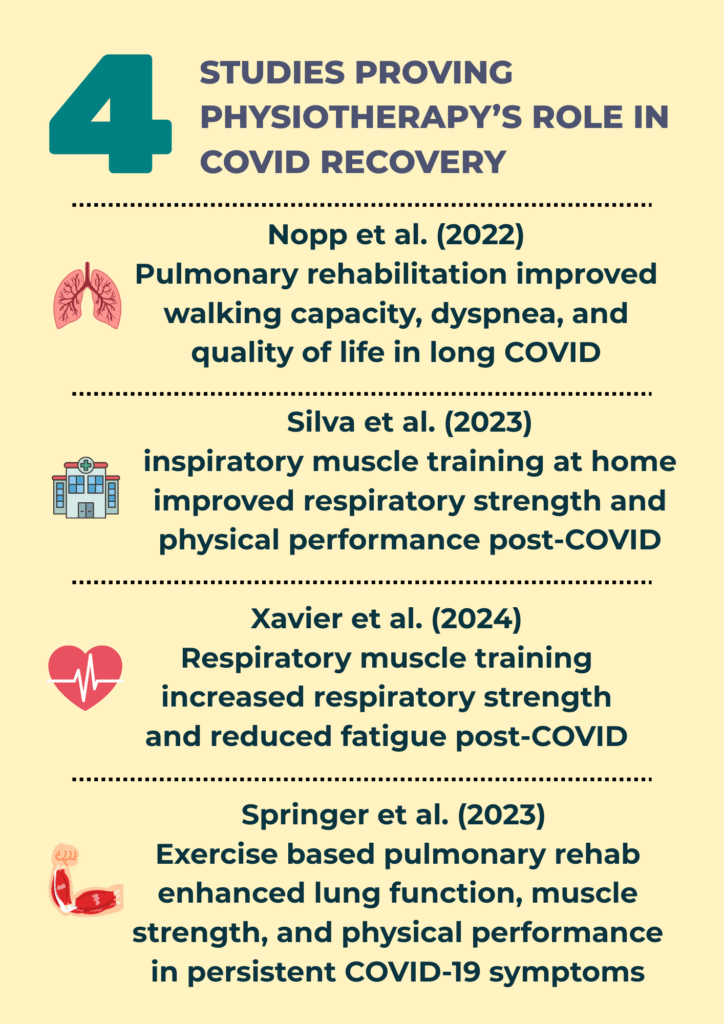
Nopp et al. (2021) in the research Outpatient Pulmonary Rehabilitation in Patients with Long COVID Improves Exercise Capacity, Functional Status, Dyspnea, Fatigue, and Quality of Life have shown that pulmonary rehabilitation involves more than just breathing exercises. Strength training, aerobic conditioning, and respiratory workouts are all part of this regimen, which enhances lung function, cardiovascular efficiency, and physical stamina. Their study demonstrates quantifiable improvements in long-term COVID patients’ ability to exercise, decreased dyspnea, and enhanced general well being.
In relation to this, the diaphragm and intercostal muscles are the specific targets of inspiratory muscle training, which has been assessed by Silva et al. (2023) in Efficacy of home-based inspiratory muscle training in patients post-covid-19: Protocol for a randomized clinical trial and Xavier et al. (2024) in Effects of respiratory muscular training in post-covid-19 patients: a systematic review and meta-analysis of randomized controlled trials. For recuperating patients, this targeted method makes routine tasks like walking, climbing stairs, and even conversing for extended periods of time substantially easier by strengthening breathing muscles, lowering fatigue, and promoting improved oxygen exchange.
Programs such as the one conducted by Manzano et al. (2023) in Effects of exercise-based pulmonary rehabilitation on lung function, muscle strength and functional capacity in post-COVID-19 patients demonstrate that exercise-based rehabilitation can recover peripheral muscle and respiratory function in more severe or chronic instances. Since post-COVID deconditioning frequently affects the entire body rather than simply the lungs, this is an important result. For instance, weakness in the legs and core muscles can further impair mobility and independence, resulting in a vicious circle of inactivity that slows down the healing process.
From the standpoint of evidence based physiotherapy, these four research together support the notion that rehabilitation is necessary and not optional. This combined evidence forms the very basis of this article, highlighting that proven physiotherapy for COVID recovery is not simply an assertion but a fact upskilled in clinical practice and scientific findings. There are quantifiable gains in strength, endurance, and quality of life with customized regimens that incorporate respiratory muscle training with increasing physical activity.
Additionally, they promote mental health by equipping patients with proactive recovery techniques, relieving stress which you can read in our article Expert Stress Relief Methods with Physiotherapy which combats the sense of powerlessness that sometimes accompanies chronic illness.
This gives readers confidence that proven physiotherapy for COVID recovery is dependable and trustworthy. It emphasizes to therapists how crucial it is to include organized interventions in therapy regimens. It gives patients and their families hope that there is more to life than just managing symptoms. Additionally, it illustrates to physiotherapy students how recent research directly translates into efficient rehabilitation techniques. In every way, the data demonstrates that physical therapy is a real, necessary part of the healing process rather than an extra luxury for COVID recovery.
Putting Research Into Practice
There is no doubt about it: a key component of post-COVID recovery is systematic rehabilitation. However, how does that appear in practice? A thorough physiotherapy evaluation that pinpoints certain limits, such as diminished lung capacity, low cardiovascular endurance, or widespread muscle weakness, often marks the start of the trip for many patients. This individualized process reflects the very essence of proven physiotherapy for COVID recovery, where tailored assessments guide targeted interventions that address each patient’s unique challenges and help restore function step by step.
Proven physiotherapy for COVID recovery naturally consists of a mix of resistance training to rebuild muscle mass, specific breathing exercises such as Diaphragmatic Breathing to retrain the diaphragm, and treadmill walking or cycling to increase stamina may be used in pulmonary rehabilitation. When used for just 10 to 15 minutes a day, respiratory muscle training devices can assist increase oxygen intake and strengthen the breathing muscles.
Case Study: Restoring Breath and Strength After Long COVID
A 44 year old male patient presented to our clinic three months after recovering from covid-19. He experienced severe exhaustion, muscle weakness, and trouble going back to work as a marketing executive, even though his tests came back negative and he was cleared medically. He had no past cardiac or respiratory issues, and his medical history was otherwise typical. Could this be a circumstance where proven physiotherapy for COVID recovery proffers the route back to full robustness and daily functioning? Let’s find out.
Following assessment, his endurance was found to be severely diminished, as demonstrated by a 6 Minute Walk Test distance of just 320 meters, which was far less than what was expected given his age and current state of health. He exhibited moderate dyspnea following light activity, with a Borg Dyspnea Scale score of 5/10. Testing of the respiratory muscles indicated significant respiratory muscular weakening, with results falling to just 60% of the expected values. His functional limitations were the inability to ascend a complete flight of stairs without stopping to rest and the physical exhaustion of routine daily tasks like carrying groceries.
We created a 6 week customised rehabilitation program that included:
- Pulmonary rehabilitation: Breathing control techniques, graded aerobic conditioning, and peripheral muscle strengthening.
- Inspiratory Muscle Training: Strengthening the diaphragm and intercostal muscles gradually with a threshold device.
- Functional training: Exercises designed to replicate the demands of daily life, such as climbing steps and carrying weighted objects.
WEEKS 1 – 2: Pulmonary rehabilitation was the main focal point, starting with fundamental breathing control methods including pursed lip breathing and ACBTs. Alongside mild peripheral muscle strengthening, low-intensity cardiovascular endurance was introduced, such as quick walks and light stationary cycling. These untimely foundations are important in illustrating how proven physiotherapy for COVID recovery set about with small but harmonious progress.
WEEKS 3 – 4: As tolerance is escalated, the patient’s walking distance and cycling time were increased, and aerobic conditioning was progressively increased in both duration and intensity. To increase the difficulty of respiratory muscle exercise, resistance gradually surged. With an emphasis on basic everyday activities including step-ups, sit-to-stand exercises, and light object handling, functional training was developed. This phase called attention to the patient’s discernible improvements and reinforced the integrity of proven physiotherapy for COVID recovery in restoring independence.
WEEKS 5 – 6: Higher levels of functional independence became the new focus. Peripheral muscle strengthening included resistance bands and small weights, while aerobic exercises were longer and more moderately intensive. To increase the potency of breathing, respiratory muscle training was continued with increased resistance. Stair climbing with additional weights simulations were added to the list of more difficult functional training exercises.
The results gave back the authentic aftermath of proven physiotherapy for COVID recovery, proving that organized rehabilitation is both effective and essential.
What you should do in case of Persistent Symptoms Post Recovery?
- Self screening – track your resting heart rate, breathlessness & the level of fatigue.
- Start with gentle breathing control exercise – inhale slowly with 3 to 4s hold from nose and exhale from mouth in a huffing manner.
- Take rest periods – follow the 20-30 rule with rest intervals if necessary
- Keep a recovery log – record your symptoms & improvement if any to report to an expert physiotherapist for a tailored program if necessary.
Prioritizing safety
Exercise has many health benefits, but it must be done safely. Patients with persistent symptoms should be screened by a healthcare professional before starting a program. Warning indications including dizziness, chest pain, or worsening dyspnea need to be reviewed by a doctor right once.
Your Road Map for Recovery
Waiting for things to “get better” is not the only thing to do if you or someone you love is suffering from post-COVID lethargy, muscle weakness, or dyspnea. Combining respiratory muscle training, progressive exercise, and pulmonary rehab into an evidence-based rehabilitation program can hasten recovery, regain independence, and enhance general quality of life.
Even while long term COVID may persist, it need not dictate your future. Collaborate with a licensed physical therapist, begin modestly, monitor your development, and acknowledge each accomplishment.
This article has been written by a Physical Therapist and provides general guidance on physical health & exercise. While it is grounded in professional expertise, it is not a substitute for individualized medical advice. If you are experiencing pain, specific symptoms, or have an underlying medical condition, please book a 1 on 1, 30 minute consultation with our expert physical therapist for a personalized assessment & tailored recommendations.
Pingback: 5 Best Exercises to Recover from Long COVID -
Pingback: The Truth about VR in Stroke Recovery -